

How to Choose a Good Dog Professional

Last week I told you that I was going to do a post to help you distinguish a good canine professional from one that is not. Choosing a dog trainer is one of the most important decisions you will make in your dog's life. The techniques you use will affect your interaction with your dog forever.
Honestly, it is not easy. Especially if you start looking without any recommendation. There are trainers under the rocks, the problem is that too high a percentage of them are not good professionals nor are they trained. Add to this the fact that there is no regulation of the profession and you have the reason why there are so many outrageous cases.

To begin with, do a little research on google and social media on their name and the school where they were trained. Look at what methods they use. If they don't even say where they were trained, it's not a very good sign.
1- Look for dog trainers/coaches who show continuous training, who attend seminars and conferences, there are always new theories and methods.
2- You have to look for a professional who mainly uses methods based on positive reinforcement, but who also does not rely only on giving rewards.
Avoid any trainer that uses force or methods based on dominance, leadership / being the alpha, or any other method that can damage the physical and mental health of the dog: no lifting of collars or hitting, no kicking, no leash pulling, no prong collars, no choke or electric, among other things we saw in the previous post.
These are not acceptable ways to train anyone. No trainee wants to be in a situation where they have to be constantly afraid of making a mistake.
3- A good instructor knows how to explain what behaviors he is training or educating, why they are important and how to demonstrate them. He will make you practice it and try to make you feel included in the training.

“The mediocre teacher says. The good teacher explains. The superior teacher demonstrates. The great teacher inspires."
4- Always be suspicious when they want to take your dog to a center for a while, please DON'T DO IT!
There are too many cases in which after being hospitalized the dogs come back worse, in terms of fear and distrust, spoiling the dog and your relationship with him. It doesn't matter if it's a few days, two weeks or a month. They don't want you to see what they are going to do. This should set off alarm bells for you. If it would be good, you could be present and take him back home every day by yourself.
5- What to evaluate if you have videos or are already in a session:
a) Look at the dogs body postures. Do they look happy and comfortable or do they look like they are afraid and only behave this way while being punished? Are their tails wagging from side to side or are they stiff, low or tucked? Are they communicating in a calm and pleasant manner or are they yelling?
b) Notice if they reward behaviors, all of them or just some of them.
c) Ask yourselves if the techniques you are using are safe for you or your children or family members to practice. In cases where the dog reacts aggressively, you can address whoever you want to perform the training technique.
Do you feel comfortable? You should feel comfortable doing whatever the trainer asks you to do with your dog. If you think your dog will not react well to a situation, ask him to explain why he is recommending that technique.
d) How are you being trained? There must be a training plan. At each step of the procedure you have to set clear and achievable goals so that the dog knows exactly what he has to do to get his reward. In the same way you have to make it super clear what you are doing in each of these steps with your dog.
e) You have to know HOW YOU MOTIVATE YOUR DOG.
Don't be afraid to ask. If the answer is with leadership, dominance, energy or any technique that focuses on using force or fear to punish unwanted behavior, discard it immediately.
Beware of those who say they use positive methods just because they use the clicker or rewards, but in truth they also punish.
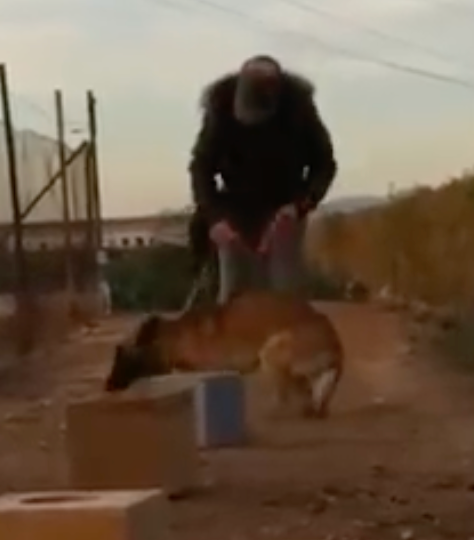
Read your dog: Look at the dog's posture, where its tail is and if it shows signs of stress!!!
Example: A video circulating on Facebook from a training center. You can find it by clicking here. You can see that he gives him treats but also kicks and various corrections, such a pity! People like this should not work in this sector and neither should they have a dog!
And now, so that you can contrast it, watch this video by clicking here. This is the way to work in positive, this is the way to use the clicker! Notice the silence, no shouting, no constant orders, no corrections, no punishment of any kind, everything is pleasant. And the best of all is the attitude of the dogs! They are happy to work, the tails go from side to side, they show motivation and very good concentration. Nothing to do with the video above that doesn't even come close to trying to train anything, other than scaring the dog.
But as I said, not everything is trained with treats! That is fine if you want to teach him some new behavior or some detection game or something like that, but unnecessary for a daily education.
f) Be suspicious if you are assured of an effective and immediate result. No conscious professional guarantees the results of the training in any term. Only the satisfaction of the services provided can be guaranteed.
g) A good trainer/coach has no problem in collaborating with a veterinarian and knows when to seek help from other professionals if there are behavioral problems.
Conclusion
It is crucial that you see that the methods used by the coach/trainer are transparent, both to the dog and to you, the caregiver. Make sure that the canine professional is trained, uses only positive methods, is respectful and has common sense and ethics.
Remember that training your dog should be a fun experience for both of you!
I hope you found the post useful.
Help me spread the word so that all dogs get the right education!
Belén


Comments