

The Best Way To Teach Your Dog

Updated: Nov 4, 2024
Hi Dog Lovers!
Today it is time to remember what positive education is and how it differs from traditional methods, which are already obsolete and are not recommended at all.
Training is the process of teaching skills or behaviors. It applies to humans, dogs, cats and other animals. Training a dog includes teaching him to respond to a verbal or visual cue. Educating a dog includes helping him learn to manage life in situations that are stressful for him.
A dog can be obedient but still have a behavior problem. Behavior problems are not fixed with obedience, you have to look at the root of the problem and treat the cause, not just the symptoms. A holistic approach is necessary, as you are going to help your dog learn to manage an emotion to be able to cope with a situation.

Learning can be defined as “any permanent change in response that occurs as a result of experience”. However, not all changes in behavior are due to learning. Some are due to a change in motivation, for example drinking water when you are thirsty.
Behavioral psychology teaches us that behavior is controlled by its consequences. If the consequences are good (we reward the dog for something we want him to do again) it is more likely that this behavior will be repeated, and conversely, if the consequences are bad (we take away the rewards or ignore when the dog does something we don't like) it is less likely to be repeated.
By definition, positive training consists of training methods based on positive reinforcement. A reinforcement can be anything that motivates the dog: voice, food, play, attention, cuddling, going for a walk, getting on the couch, etc. Just like us, dogs learn best when their achievements are reinforced. Rewarding the dog maintains external motivation and contributes to bonding. Conversely, always telling your dog that what he has done is wrong will demotivate and frustrate him.
Imagine you have failed an exam. Would it help if the teacher yelled at you and hit you? A good teacher would help you prepare better for next time, try to improve his teaching methods and encourage you to keep up your efforts. Well, we are our dogs' teachers. The next time your dog does something you don't like, ask yourself how you can help him do it right the next time.
It is important to remember that no one does anything for free, not even our dogs. However, we should not always educate them using treats. Although rewards help them learn new things, not all their actions require reinforcement. It is essential that the dog understands that some things are part of his routine, without the need for a reward every time.
To achieve meaningful learning, it is more effective to encourage cooperation and autonomy than to rely on punishment or immediate rewards, which are methods of control. In this way, we promote his internal motivation and prevent the dog from expecting a reward whenever he performs a task. This can avoid frustrations and help him learn to do things simply by being part of his daily life.
Encouraging independence and making him understand that some things come naturally to him contributes to his confidence and balance. Creating an environment that stimulates his curiosity and desire to learn, allowing him to explore and giving him support, is key to his development.
In summary, establishing a clear routine where the dog knows what is expected of him, without always relying on rewards, will make training more effective and strengthen your relationship with him.
How to say “no"
Using methods based on positive reinforcement doesn't mean you can't say no to your dog. You just have to tell him in a way he understands, not in human language. You can:
Ignore the behavior: don't give it attention, so you won't reinforce it.
Avoid the situation: manipulate the environment so your dog always does well.
Teach him an alternative behavior. Example: if your dog jumps up you will turn around ignoring that, but will go for a toy so he can chew and relax, or you can ask him to look for something (make sure he knows what you have hidden) and when he finds it he will have his own reinforcement.
Why not to punish
Physical punishment, force and intimidation have no place in the education of a dog. Punishment scares the dog and fear inhibits learning, i.e., the only thing the dog learns is to be afraid of the punisher. And worse, many studies show that punishment often results in serious behavioral problems such as fear, anxiety and aggression disorders. Logically, if we add something bad that the dog doesn't like we run the risk of creating negative associations in our dogs. This is dangerous.
These methods are very much seen in famous TV figures, but don't be fooled, they are not ethical and in the long term they are not effective, that is, the dog's problem ends up coming out on one side or the other, if it hasn't already worsened.
I feel very helpless to see that there are people who claim to be trainers and teach methods such as hitting, growling, “being the alpha/leader” or dominating the dog, forcing him, throwing him to the ground to dominate him, grabbing him by the jaws and shaking him, putting spike collars, choke collars or electric collars, among other nonsense. None of this will help your dog! Although in some cases it may seem that the problem stops, it does not, the problem will come back and it will be worse. Neither fear nor aggression (which is mostly caused by fear) can be treated with these methods. Fear brings more fear. Period. If you know someone who has been recommended to use these methods, warn them that, apart from the suffering and pain they are causing their dog, they are creating a time bomb.
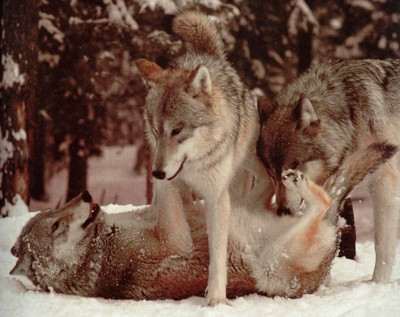
The dominance theory has been debunked long ago, it is a myth that spread based on a single research on wolves in captivity that has already been proven wrong. In the references you can read more about it. I am going to dedicate a post to help you all to know how to find a good canine professional, with training and ethics, that will not harm the mental and emotional state of your dog or your relationship, but will improve your bond and solve the problem. I think this is a very important issue, since there is no regulation in this profession and there are too many bad trainers everywhere.
For the moment be suspicious of anyone who tells you that the dog wants to control or dominate you, that you have to be the alpha or teach him who is the boss and this kind of comments. This way you can recognize that they are not positive educators, but traditional handlers.
Conclusion
Training methods are key to avoid future behavioral problems. The relationship and trust between the dog and its handler are essential for a good outcome. The use of positive reinforcement instead of punishment is undoubtedly the most effective way to strengthen the bond between dog and handler and reduce the risk of aggressive behavior in the dog, but remember that it is not always necessary. You have to let the dog be a dog, promote an environment where he can explore and learn what he needs, without so much human intervention.
Hopefully soon it will no longer be necessary to clarify whether training is positive, because positive training should always be the norm, with a proper balance between reinforcement and development of independence.
I'd love to know what you think!
See you soon!
Belen
REFERENCIAS Y MÁS LECTURAS
Punished by Rewards, Alfie Kohn.
John W.S., Bradshaw , Emily J., Blackwell , Rachel A., Casey. Dominance in domestic dogs — useful construct or bad habit?
Journal of Veterinary Behavior: Clinical Applications and Research, May/June 2009, Pages 135-144 [link]
Clark and Boyer, (1993) The effects of dog obedience training and behavioural counselling upon the human-canine relationship. Applied Animal Behaviour Science 37 (2) 147-159.
Herron, ME, Shofer, FS, Reisner I (2009) Survey of the use and outcome of confrontational and non-confrontational training methods in client-owned dogs showing undesired behaviors. Applied Animal Behaviour Science 117 47–54.
Azrin NH. 1960. Effects of punishment intensity during variable-interval reinforcement. J Exp Anal Behav 3: 123-142.
Yin S. 2009. Dominance vs. unruly behavior. The APDT Chronicle of the Dog, Mar/Apr 2009, pp. 13-17.
Yin S. 2009. Low Stress Handling, Restraint, and Behavior Modification of Dogs and Cats. Cattledog Publishing. Davis,CA. www.askdryin.com
Bennett P, Rohlf, V. (2007) Owner-companion dog interactions: Relationships between demographic variables, potentially problematic behaviours, training engagement and shared activities. Applied Animal Behaviour Science 102, 65–84.
Rebeca Wild. Libertad y límites. Amor y respeto: Lo que los niños necesitan de nosotros.


Comments