

The Dominance Myth: Leading Your Dog With Trust, Not Fear

Updated: Mar 3, 2025
Hello again, dog lovers!
Today's post might be a bit controversial. I hadn’t planned on tackling this topic on my blog, as there are already plenty of articles debunking the dominance theory. However, I’ve realized it's still very necessary because:
Several people have asked me about the "alpha roll" and dominance in dogs over the past month.
Many dog owners continue using incorrect training methods due to a misunderstanding of this concept.
Too many of my acquaintances are fans of Cesar Millan.
So, here we are! I feel it's my duty to share this information with you in the easiest and lightest way possible. 😉
Why Are Humans So Drawn to the Idea of Dominating Their Dogs?
Is it the need to feel superior? (Humans have always been hierarchical in society.) Is it the desire for total control? Power?
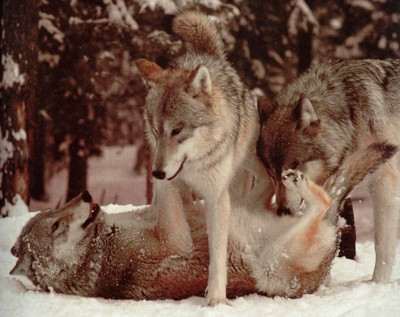
In animal behavior, being dominant refers to establishing rank/status through force and aggression to gain priority access to resources (food, mating, resting areas, etc.). So why do so many trainers and owners still believe that using force and intimidation to be the "alpha" is the correct way to train their dogs?
People have twisted the concept of dominance to justify power, rank, and control through force, misinterpreting canine relationships and social hierarchies. This has led to incorrect methods of handling and training dogs.
Here are some of the myths we dog trainers hear all too often—not just from the general public but from owners influenced by outdated training ideologies. I hope most of these sound as ridiculous to you as they do to me. If not, just know that they are completely false:
If your dog walks through the door before you, they’re trying to dominate you.
If they jump on the couch without permission, they’re asserting dominance.
If they paw at you, they’re trying to control you.
You should eat before your dog to show them you’re the alpha.
If they lie in the middle of the room, don’t walk around them—make them move.
Never let them sleep in your bed or on the sofa, or they’ll think they’re in charge.
Don't let them put their head above yours—it’s a sign of dominance.
Don’t clean up after them if they’re watching, or they’ll see you as submissive.
And the list goes on...
The Science Says Otherwise
Research has repeatedly shown that forcing submission has nothing to do with how animals, including dogs, establish relationships—whether with each other or with us.

Let’s talk about the outdated concept of the alpha. The idea of "alpha" suggests competition and fighting to reach the highest rank. However, in reality, most wolves that lead a pack do so simply because they are the parents—they mate, produce offspring, and their family forms the pack. So, instead of calling them "alphas," they are now correctly referred to as breeding pairs or parents (e.g., "breeding male," "breeding female," "adult male/female"). Even David Mech, one of the leading wolf biologists who initially helped spread the alpha theory, later admitted it was incorrect. Check the famous video here.

The confusion comes from the fact that the studies that inspired dominance-based dog training methods (popularized by figures like Cesar Millan and Borja Capponi) were conducted on captive wolves. These packs were made up of unrelated wolves from different backgrounds, which disrupted natural family structures and led to unnatural conflict.
However, wild wolves rarely show aggression toward members of their own pack. More importantly, submissive postures are never forced by a more "dominant" wolf— they are offered voluntarily and naturally. (So let’s back up science with common sense: no more forcing dogs onto their backs or using those bizarre techniques we see on TV!)
In the wild, animals that rely on brute force don’t survive. Such behavior wastes energy, increases the risk of injury or death, and makes the animal vulnerable to predators. Cooperation and group cohesion are far more critical to survival than aggression and conflict.
Hierarchy Exists, but it’s not about Aggression
A pack functions as a family, not as a dictatorship. Hierarchy is not enforced through aggression but rather through parental guidance. This means that dominance and aggression are not the same thing. In fact, the so-called "alpha" is often the least aggressive member of the group because they have no need to prove anything.
The biggest mistake in all of this was extrapolating observations from captive wolves to domestic dogs. This led to the belief that dominance-based training is the key to solving behavioral issues—when, in reality, nothing could be further from the truth.
Training techniques based on dominance involve punishment, intimidation, and fear—exactly the opposite of what a dog needs to overcome behavioral challenges.
On top of that, applying a one-size-fits-all concept to every dog is absurd. It’s like assuming all humans are the same. This is why our education system struggles—because it doesn’t accommodate different learning styles, leading many kids to become discouraged and drop out when their needs aren’t met.
Dogs can’t drop out of the system, but they do shut down. Many dogs become depressed (yes, this happens more often than people think). They develop learned helplessness, in other words, they give up.
🚫 You don’t need to dominate your dog to educate them.
✅ You need to be their guide, their safe base, their source of confidence.
This is how dogs (and all living beings) learn best!
Spread the word so more people can build a healthy, respectful bond with their dogs.
For a relationship based on trust and respect! ❤️🐶
Belen
REFERENCES:
Outmoded notion of the alpha wolf by David Mech
De-Bunking the "Alpha Dog" Theory by Pat Miller
Down With Dominance by Patricia McConnell
The Dominance Controversy by Sophia Yin
MÁS LECTURAS:
Barry Eaton's Book: Dominance ¿fact or fiction?



Comments